Sunday, May 17, 2015

Gypsies in Adams Township - 1894


From the Defiance Democrat - November 1, 1894
In the social column...
"ADAMS.

A. Pessefal has a fine brick cellar completed.

The Coressel Bros., J. P., Al and Jake, allowed their fine black mustaches to succumb to one of the whithering frosts of last week.

John Walk and sister, Mrs. Sophia McNamara of The Bend were guests of Mrs. Henry Co, Henry Coressel Sunday last.

Several natives of the Transylvanian Alps passed through here last Sunday accompanied by a number of bears.  They were very dirty and begging was their profession.
The nomadic "gypsies" were usually from Romania or surrounding areas and were greeted with skepticism by the locals.

The appearance of the Catholic cemetery on the Ridge was improved by the construction of a new fence and a general cleaning up of the grounds.  The work was done last Monday.  The members of the congregation turning out en masse.

On October 20th, Ferd Mikus (Mekus) was up before Squire Sheets to answer to a charge of assault and battery preferred by John Moser.  It seems that on sundry occasions Moser had assumed pugnacious attitudes toward the defendant and even plainly intimated that he 'lied' about certain things, whereupon Ferd, consulting his manhood, literally 'mopped the earth' with said Moser.  Hence his appearance before justice.  Ferd pleaded guilty to the charge and paid a fine of five dollars and costs, amounting to ten dollars in all.

Next Tuesday is election.  It is expected that every voter in Adams township will be out as the question of 'relief' for P. J. Schwartzel, treasurer who was caught in the wreck of the defunct Savings bank, is to be voted upon."

Wednesday, May 13, 2015

Eisenhower and the Defiance College - The Back Story

Almost anyone familiar with Defiance, Ohio, knows the story of President Eisenhower's visit to the city in October, 1953, thanks to Kevin McCann.  McCann was a former speechwriter and biographer for Eisenhower and eventually, McCann became president of the Defiance College. The plan was for President Eisenhower to visit the college, speak for 15 minutes and then lay the cornerstone for the college's new library.
Obviously, when a President of the United States makes his way to Defiance, it was historic. Preparations had to be made. A parade route was established from the downtown area out to the college, extra law enforcement was brought in, dignitaries were invited, and school was dismissed for the day so thousands of school children could view the president.


Ohio Memory Project - Defiance Library.  Ike greeting the crowds in downtown Defiance.


 Drew Pearson, a noted columnist of the day, published a column nationwide on October 20, 1953, after the event, that told some of the behind the scenes facts behind Eisenhower's visit.

"EN ROUTE THROUGH THE MIDDLE WEST.
There was a special reason why President Eisenhower stopped at the Defiance college in Defiance, Ohio, en route to the Mexican border.  That reason had to do with 200 special cigars in glass containers prepared by the American Tobacco company and labeled, 'Defiance welcomes the Eisenhowers, September 1953.'

Actually Ike got there in October, so the cigars weren't quite up to date, nevertheless he got there.

And the story behind all this is that Kevin McCann, president of the Defiance college - Dr. McCann insists upon the 'the' - had obtained a promise from the president last summer that he would stop off at Defiance, Ohio enroute home from Denver.  Dr. McCann is Ike's original biographer and wrote the book syndicated in many newspapers last year which helped to prepare for his nomination.

And having obtained the promise that Ike would stop over, McCann proceeded to get ready for him.

He spent $150 on a new cornerstone, raised a lot of money to extend the runways of the Defiance airport so Ike's big plane could land, and had the special cigars made for 200 guests.  Furthermore, the city of Defiance turned out with gala decorations - when suddenly McCann got a wire from the president, reading:

'Sorry, we won't be able to stop at Defiance on way home, Kevin.  We have to stop in Chicago to pick up the kids.'

He referred to the fact that he had to pick up his grandchildren who were visiting in-laws at Fort Sheridan, Illinois.

McCann got a bad razzing from the folks at Defiance, and for a time, he didn't feel much like living there.  However, he went to Washington, made a personal appeal to the President, and Ike finally decided to stop at Defiance in October, not September."


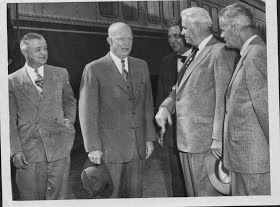
L to R: Mayor Rost, President Eisenhower, Gov. Frank Lausch, Sen. John Bricker, and DC President McCann -at the train
 (Photo - courtesy of the Defiance College Pilgrim Library Archives)

Whew...job well done, President McCann, and it couldn't have been easy.  I'm looking for a photo of one of those special cigar cases and I haven't been able to find one.  The Defiance College no longer has the Eisenhower room and the items there have been dispersed.  Wonder if any cigar cases still exist?  
Update!  Thanks to Susan for this photo of the Eisenhower cigar case!


Tuesday, May 12, 2015

Washington Township News - November 1894

From the Defiance Democrat - November 15, 1894

"NORTHWEST WASHINGTON

John Hammersmith's house was destroyed by fire last Sunday.  Fully insured.

The township road at John A. Moon's has been changed so as to do away with the Prairie Creek bridge.

Chas. Strahle has purchased the old Bayes farm of E. Stone, who will occupy the Ufer farm.

W. A. Walker has moved to Milford township, where he will teach school this winter.

There are no empty houses in Ney at this writing.

Sam Burke's new residence is completed.

John Beattie is preparing to move on his farm at Pleasant Point.

Frank Ury will soon move to Defiance.

George W. Hanna, of Tiffin township, says he thinks he saw a bear recently.  Perhaps it is the same one that Superintendent Cook saw some time ago.

Mrs. B. E. Struble is preparing to move to Bryan.  Her brother William will farm her place.

Barney Wood and daughter, Mrs. Walter Donley, of Hicksville, have moved on her farm in this township.

 The schools of this township are about to begin work for the winter, with the following teachers:
Dist. No. 1 - Mrs. Laura Koeppe
Dist. No. 2 - U. G. Figley
Dist. No. 3 - Della Iferd
Dist. No. 4 - George McConkey
Dist. No. 5 - G. W. Shoe*
Dist. No. 7 - M. D. Huffman
Dist. No. 8 - E. W. Bayliss, and
Dist. No. 9 - Warren Johnson"


* No District No. 6 was listed. 

Sunday, May 10, 2015

Kathryn Singer - A Tragic Accident


From the Marckel Scrapbook


KATHRYN SINGER

“PECULIAR DROWNING.   

Little Girl Meets Death in Trough.   

Drowned in But One Foot of Water 
– Sad Bereavement to Mr. and Mrs. George Singer.


One of the saddest misfortunes that has occurred in the vicinity of Defiance for many years took place at the home of George Singer, the Dairyman, in Noble township Friday evening at about 6:00 o’clock in which little Kathryn, the eighteen months old daughter of Mr. and Mrs. George Singer met death by drowning in the big watering trough in the barnyard.


The little girl had accompanied an older sister and her father to the barn.  She had intended hunting for eggs as was her custom each evening. Although her father kept watch of her as he always did when she visited the barn, she became lost from him in some way.  Returning to the house, he happened to look into the watering trough and there was his child.  She was immediately removed and every measure taken to restore life.  

 Physicians were called from Defiance but were unable to revive the spark of life.  The little girl had drowned in a foot of water.  The child could not have been in the water over fifteen minutes.

The funeral occurred Monday morning at 9:00 o’clock from St. Mary’s Catholic church, Rev. Collins officiating.  Burial was in Riverside.”

I believe this to be the correct tombstone, located in Riverside Cemetery.  On this Mother's Day, we remember the tragedy of so many who lose a child too soon.
 

Thursday, May 7, 2015

Have You Visited the Old Apple Tree?

One of the first mentions of the large, apple tree that once stood on the north side of the Maumee across from the library in Defiance appeared in the Pictorial Field Book of the War of 1812 by Benson J. Lossing, 1869, Chapter XVI.
He wrote of his visit to Fort Defiance about sixty-five years after Fort Defiance was abandoned as a military site.

"I visited the ruins of Fort Defiance on a warm, sunny day late in September, 1860.  I came up the Maumee Valley by railway from Toledo on the previous evening, and arrived at the Defiance station at midnight.  The village of Defiance lying mostly on the Maumee, upon the beautiful plain at the confluence of that river and Au Glaize, was shrouded in a chilling fog.  Warned of the danger of the night air in that valley at that season of the year, I felt as if fever and ague were inhaled at every inspiration while walking a long distance to the hotel.  There was all darkness.  A slumbering attendant was finally aroused, and I was directed by the feeble light of a small candle to a most cheerless bedroom at one o'clock in the morning.

After an early breakfast I went out to find the historical localities of the place, and was fortunate enough to be introduced to Mr. E. H. Leland and Doctor John Paul, who kindly accompanied me to them.  We first visited the interesting remains of Fort (Defiance) on the point of land where the two ruins meet.  We found the form of the glacis and ditch very distinctly marked, the remains of the former rising six or eight feet above the bottom of the latter.  The shape of the fort was perfectly delineated by those mounds and the ditch.  Some large honey locust trees were growing among the ruins.  These have appeared since the fort was abandoned in 1795.  One of them, with a triple stem, standing in the southeastern angle of the fort, measured fifteen feet in circumference.  These ruins are likely to be preserved.  The banks were covered with a fine sward, and they were within an inclosure containing about two acres of land, which the heirs of the late Curtis Holgate presented to the town.

Pictorial Field Book of the War of 1812, Benson Lossing, 1869
 We visited the site of Fort Winchester, a little above Defiance, on the bank of the Au Glaize, and found the remains of many of the pickets protruding from the ground.  Across a ravine,just above the fort, was the garrison burying ground.  We returned to the village, crossed the long bridge which spans the Maumee, and from the heights of Fail's Grove, on the eastern side of the river, obtained a comprehensive view of the two streams at their confluence, the site of the fort and the village of Defiance.  The sketch there made is here given...

On our return to the village we visited on the way, near the margin of the Maumee, an aged and gigantic apple-tree, coeval (equally old), no doubt , with the one near Fort Wayne.  We found it carefully guarded, as a sort of 'lion' of the place, by a high board fence, the ground around it, within the inclosure, thickly covered with burr bearing weeds. It was upon the Southworth estate, and access to it might be had only through a small house near.  That tree was a living monument of the French occupation of the spot, as a trading station, long before any other Europeans had penetrated that remote wilderness.  It measured about fifteen feet in circumference eighteen inches from the ground.  The figure standing by it affords a fair criterion for judging of its size, by comparison with the body of a stout man.  We returned to Defiance in time for dinner, and left with the early train for Fort Wayne."
 
Sketch of the apple tree in Lossing's book, mentioned above

 
Hicksville News
Thursday, October 28, 1886
Page 1

"-- Here is a little more history of the old apple-tree, blown down in the storm, two weeks ago:
The old apple-tree, on the north bank of the Maumee, at Defiance, was remarkable for its age.  When the first white settlers cleared the forest along the river, they found a row of apple-trees, which, according to the Indian tradition, were planted by missionaries, prior to the 18th century.

The one just destroyed was the last to succumb to the ravages of time and storm.  It was a large tree, and beneath its spreading branches, Occonoxee, the last Indian chief of that locality, was born.  He died over forty years ago, at the ripe age of 83.

The Indians almost held the fruit trees in veneration, and visitors to old Fort Defiance, have always had pointed out to them, the veteran tree, just across the river, standing like a ghostly picket upon the lines between past and present.

At one time, this tree measured 7 feet in diameter and 26 feet in circumference, and was known as the largest apple-tree in the United States, if not in the world.  Nobody knew the age, but Occonoxee, a chief of the Pottawatonies, who was 80 years old at the time, told one of our citizens, 50 years ago, that he was born under that tree.  From this it can be seen that the tree must have had an age of at least 150 years.

When the sun was at its zenith, its shadow was 50 feet wide, and it had been known to bear as high as 200 bushels of apples in one crop.  Due reverence for such a fallen monarch would call for its being made up into momentoes such as canes, etc."

Today the location of the old apple tree is marked by a stone monument on top of a large tree stump which indicates the size of the tree.  Although the statistics differ, depending on the source, we can all agree it is a great historical reminder of the roots of early Defiance.


Monday, May 4, 2015

Defiance County Pioneers - Hal Miller

Photo on www.findagrave submitted by Bill Metz
November 28, 1912

"DIES SUDDENLY

Hal H. Miller, Marshall and Fire Chief

Stricken with Heart Failure While in the Discharge of His Duties at the Jail

Horace H. Miller, city marshal and chief of the local fire department for a number of years, died suddenly at four o'clock Wednesday afternoon, November 20, of heart failure, while in the discharge of his duties at the jail.

During the afternoon,he had been called to quiet a disturbance at the home of William Wallace.  It was necessary to arrest and confine Wallace to assure the peace and safety of members of his family.  This was only accomplished with much difficulty, in which Mr. Miller was forced to exert himself, as Wallace showed fight, flashed a gun and threatened to take his (Miller's) life.

However, after Wallace had been safely incarcerated, Mr. Miller secured Walter Smith to assist him in making repairs at the jail.  The stove pipe needed fixing and a window light replacing.  On the way to the jail, Miller complained of a severe pain in his chest.  Arrived there, he told Smith to take the measurement of the window while he built a fire.  After laying the kindling in the stove,he took a bucket and went after coal.  He had just returned and reached the door of the jail when the fatal stroke fell.

Smith heard the clatter of the coal bucket, but supposed Miller had slipped off the step and fell.  He went to the door and spoke.  Seeing Mr. Miller laying on the ground, motionless, he bent over him and attempted to raise him up.  Receiving no replies to his inquiries, and thinking that something serious had happened,he hastened and secured the assistance of Clyde Maxwell and W. N. Bates.  While one went after Dr. W. H. Cook, the other two did all they could for the stricken man.  Upon the arrival of the physician, he was removed to his home on Cornelia Street.

The stroke, seemingly, had proved instant and fatal, and its victim never regained consciousness and expired a moment after its visitation.  Whether or not the excitement of the arrest and incarceration of Wallace was instrumental in bringing on the attack is mere conjecture.  The word that Mr. Miller, a faithful friend of all, a good citizen, and an exemplary officer had died suddenly soon spread and the people of the town (Hicksville) were cast into sadness and gloom.

Mr. Miller was a man in every sense of the word.  He met and conquered reverses that would have discouraged a less stronger spirit.  His temptations were many and sore, yet he overcame them and the past several years of his life have been lived as only the good and true, noble and big hearted people can live.

The remains lay in state at the late home until Sunday.  The funeral was held at the Presbyterian church at 2 o'clock Sunday afternoon and was in charge of the local fire department.  The cortege was accompanied to the church by a large body of people, headed by the Hart Concert Band, a large delegation from the Defiance fire department and county officials, and the entire membership of the local department in uniform.  The services were conducted by Rev. J. N. King, pastor of the deceased, assisted by Reverands P. O.Rhodes, D. F. Harris, and D.G. Hall.  Congressman Ansberry was in attendance at the funeral and spoke feelingly of the close bond of friendship that had existed between himself and the deceased for a number of years.  Mayor E. C. Bear paid a touching tribute to Mr. Miller's record as an official of the town and also of the fire department."

Included in the obituary were the words of Dr. J. W. Lilly who spoke to the funeral crowd as a representative of the fire department.  He noted that Hal Miller was a charter member of the first fire company in Hicksville in 1874 and also a charter member of the Union Hose, Hook and Ladder Company organized in 1890.  He first served as an assistant chief and in 1894 was elected Chief of the Department and re-elected again in 1911. He had 38 years of public service and was loved by the "boys."

"H. H. Miller (Horace H.), son of Abraham and Eliza Miller, was born in Fredericksburg, Wayne county, Ohio, September 12, 1851.  In 1855 he came with his parents to Hicksville, Ohio, where he resided until his death on November 20, 1912, at the age of 61 years, 2 months and 8 days.  He was one of a family of twelve children, six boys and six girls, nine of whom are still living, his father, mother, two brothers and two sisters preceding him to the life beyond.
On October 12, 1871, he was united in marriage to Cynthia Steele, to which union were born eight children, six boys and two girls.  He has left to mourn his loss, three brothers and four sisters, his wife, five sons and two daughters and ten grandchildren, together with a host of relatives and friends.

The remains were accompanied to Forest Home by a large body of people from near and far, and the last sad rites were performed and the soul of a beloved citizen was committed to its Master."

Forest Home Cemetery, Hicksville, Ohio - www.findagrave
 Source: Obituaries: Pioneers of Northwest Ohio, Volume 1.  Carma Rowe Estate (Johnson Memorial Library).  No date.  p. 207.
 Copies available at Defiance Public Library and Hicksville and Sherwood branch libraries.

Saturday, May 2, 2015

Jericho School #8, Hicksville Township

Jericho School District #8
Hicksville Township
(Located on the northeast corner of Jericho and Price Roads)

1923 - 1924

Homer E. Applegate, Teacher
W. E. Manahan, County Superintendant
H. S. Armstrong, District Superintendant

Pupils
Nina Evans
Dallas Whitman
Ruth Fry
Eleanor Evans
Frances Olson
Marietta Banks
Lavon Banks
Robert Olson
Opas Shull
Norman Cottrell
Lucy Shull
Delmar Anderson
Clyde Evans
Paul Evans